Recruitment
Two research fellowships for Master's graduates: apply by 27 October 2026
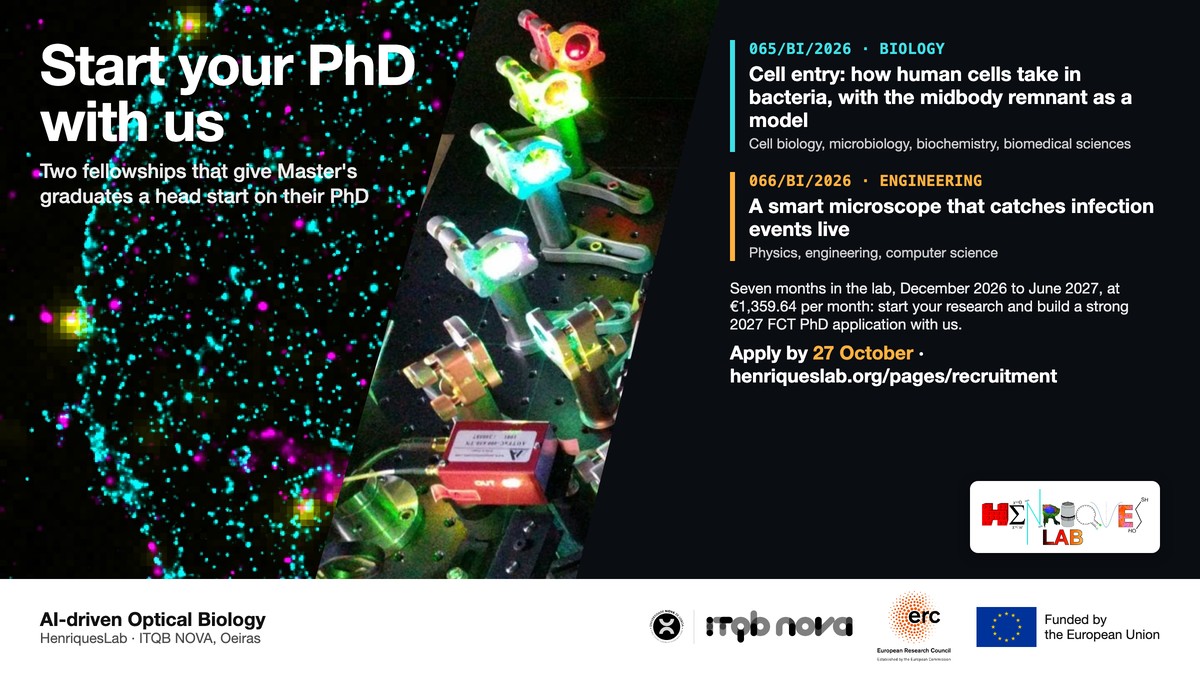
We offer two research fellowships that give Master's graduates a head start on their PhD. Each fellow spends seven months in the lab, from December 2026 to June 2027, starting their own research and building a strong application to the 2027 FCT PhD studentship call with Ricardo Henriques. Fellows learn the methods, test ideas and gather the first results that the PhD project will build on. The fellowships pay €1,359.64 per month and are funded by our ERC Consolidator Grant, SelfDriving4DSR.
065/BI/2026: Cell entry: how human cells take in bacteria, with the midbody remnant as a model
Bacteria such as Staphylococcus aureus enter human cells by triggering their own engulfment, and the order of host events during entry is still unresolved. This project studies cell entry with a natural model: the midbody remnant, a bacterium-sized particle released at every cell division and later engulfed by the dividing cell or its neighbours. You will use adaptive, AI-guided microscopes to follow remnants from their release to their uptake, map the order of host events during engulfment, compare them with S. aureus entry, and measure how taking in a remnant changes the next division of the receiving cell.
The call suits Master's graduates in cell biology, microbiology, biochemistry, biomedical sciences or a related field, with lab experience that includes cell culture. Programming experience helps, and we teach it from the start. Full call on EURAXESS.
066/BI/2026: A smart microscope that catches infection events live
You will build a smart microscope that detects infection events in live cells with neural networks, triggers fixation through the lab's NanoJ-Fluidics pump system, and images the same cell by single-molecule localisation microscopy at about 20 nm.
The call suits Master's graduates in physics, engineering, computer science or a related field, with programming experience in Python or another language and an interest in biology. Biology lab experience is optional; experience in optics, hardware control or machine learning counts in your favour. Full call on EURAXESS.
Who can apply
You need a Master's degree completed by 30 November 2026 with a final mark of at least 14/20 or equivalent. You may apply before you finish; the award then depends on completing the degree by that date. You also need good spoken and written English, the intention to apply with the lab to the 2027 FCT PhD studentship call, and enrolment, by the start date, in a doctoral programme or a non-degree course, as Article 6 of the FCT research fellowship regulations requires.
How to apply
Email a motivation letter, a detailed CV and copies of your degree certificates to Ricardo Henriques ([email protected]), with your name and the call reference in the subject line. Applications close on 27 October 2026 at 23:59 Lisbon time. We select on CV review (60%) and an interview with the shortlisted candidates (40%).
Other routes into the lab
We welcome researchers who want to join the lab through their own fellowship. Postdoctoral candidates can apply with us as host to the MSCA Postdoctoral Fellowships and the EMBO Postdoctoral Fellowships. Doctoral and postdoctoral candidates can also apply to the calls of the Portuguese Foundation for Science and Technology (FCT). To discuss an application, email Ricardo Henriques (details on the contact page) with your CV and a short note on the project you have in mind, a few months before the call deadline.