VLab4Mic: prediction of structural resolvability in super-resolution microscopy
Technologies: EZInput (), mAIcrobe (), nano-org, NanoJ (), NanoJ-SQUIRREL (), Nuclear-Pores as references and ZeroCostDL4Mic ()
Preprint published in bioRxiv, June 2026
Publisher: Cold Spring Harbor Laboratory
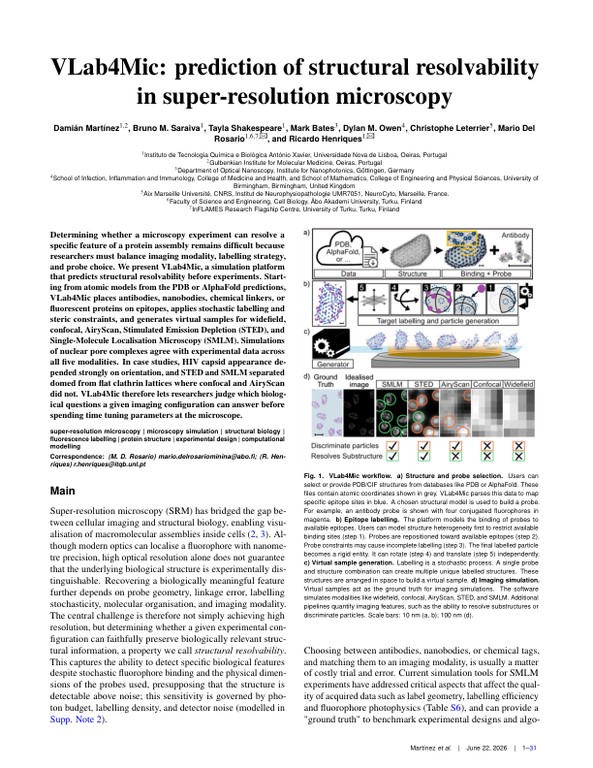
Determining whether a microscopy experiment can resolve a specific feature of a protein assembly remains difficult because researchers must balance imaging modality, labelling strategy, and probe choice. We present VLab4Mic, a simulation platform that predicts structural resolvability before experiments. Starting from atomic models from the PDB or AlphaFold predictions, VLab4Mic places antibodies, nanobodies, chemical linkers, or fluorescent proteins on epitopes, applies stochastic labelling and steric constraints, and generates virtual samples for widefield, confocal, AiryScan, Stimulated Emission Depletion (STED), and Single-Molecule Localisation Microscopy (SMLM). Simulations of nuclear pore complexes agree with experimental data across all five modalities. In case studies, HIV capsid appearance depended strongly on orientation, and STED and SMLM separated domed from flat clathrin lattices where confocal and AiryScan did not. VLab4Mic therefore lets researchers judge which biological questions a given imaging configuration can answer before spending time tuning parameters at the microscope.